Hand Luggage: Everything You Need to Know Before You Fly
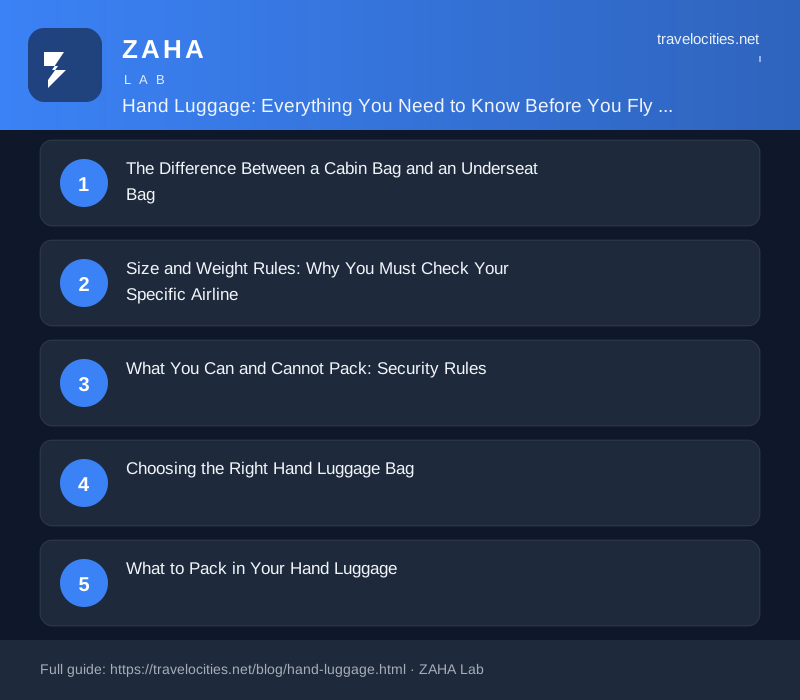
One centimetre can cost you £50. Travellers are turned away at the gate every single day because their cabin bag is fractionally outside the airline's size gauge, and the last-minute hold fee stings far more than the bag ever did. Hand luggage rules have never been trickier to navigate, so here is exactly what you need to know before you pack.
Hand luggage is any bag you carry onto the aircraft and store in the overhead locker or under the seat in front of you. Most airlines permit at least one piece per passenger, but the permitted size, weight and whether a second smaller bag is included depends entirely on your airline and your fare type, and you must check those specifics yourself before you travel.
The Difference Between a Cabin Bag and an Underseat Bag
These two terms are often used interchangeably, but they describe different things, and knowing the difference matters when you are choosing a bag or reading an airline's policy page.
A cabin bag (also called a carry-on or overhead locker bag) is the larger of the two allowances. It goes in the overhead locker and is subject to the airline's main hand luggage size and weight rules. Dimensions are typically stated as height × width × depth, and the measurement usually includes wheels and handles, not just the fabric body of the bag.
An underseat bag is a smaller, secondary item, a handbag, laptop bag, small backpack or tote, that slides under the seat in front of you. Some airlines include this in their basic fare automatically; others only allow it on higher fare tiers; some budget carriers now charge for it separately. Again, check your specific booking.
If you are flying on a budget carrier with a basic fare, there is a real chance you are only entitled to a small underseat bag and will need to pay extra for overhead locker access. Read your confirmation email carefully or log into your booking to see exactly what your fare includes before you arrive at the airport.
Size and Weight Rules: Why You Must Check Your Specific Airline
There is no universal hand luggage size. Airlines set their own dimensions, they change them periodically, and the rules can differ between routes, aircraft types and fare classes on the same airline. We are not going to quote specific centimetres here because doing so could mislead you, figures from any published guide, including this one, may already be out of date by the time you read it.
Instead, here is how to get the accurate number for your trip:
- Go directly to the airline's own website and search for "hand luggage allowance" or "cabin baggage." Every major carrier publishes this page.
- Check the fare class you booked. A basic economy or "light" fare almost always has more restrictive rules than a standard or flexible fare.
- Note whether the dimensions include the wheels, handles and outer pockets. Most do, but not all.
- If you are connecting via a different airline, check both carriers, the stricter of the two applies.
- Screenshot or print the policy page with the date, so you have evidence if there is a dispute at the airport.
Weight limits vary even more wildly than size limits. Some carriers impose no weight restriction on cabin bags at all; others cap them at a figure that a moderately packed bag will exceed. Weigh your bag at home on bathroom scales before you travel. Catching a problem in your bedroom costs nothing. Catching it at the gate costs a great deal.
What You Can and Cannot Pack: Security Rules
The security rules governing what you carry onto a plane are set by the government and applied at the airport, not by the airline. The rules that apply to you depend on which country you are departing from, not your nationality, not your destination.
Liquids. When departing from UK airports, you are generally permitted to carry liquids in containers of up to 100ml each, placed in a single transparent, resealable bag. However, the UK has been in the process of rolling out new technology at several airports that is intended to allow larger liquid containers to pass through, the rules at specific airports have been shifting. Check the government's official advice and your departure airport's website before you travel, as the situation may have changed since this was written.
Electronics. Laptops, tablets and larger electronic devices will usually need to be removed from your bag and placed in a separate tray at security. Keep them accessible in your bag rather than buried at the bottom. Portable battery packs (power banks) must go in your cabin bag, not your hold luggage, most airlines prohibit lithium batteries in checked bags. Check the specific watt-hour limit your airline applies, as very high-capacity banks may be restricted.
Sharp objects. Scissors with blades longer than a certain length, razor blades, and similar items are typically not permitted in cabin baggage. The exact rules are available on the government's airport security guidance page. If you are in any doubt about an item, either pack it in your hold luggage or leave it at home.
Medications and baby items. Prescription medications can generally be carried beyond the 100ml liquid rule, but you should carry a prescription letter from your GP, especially for injectable medicines. Formula, breast milk and baby food are also normally permitted in reasonable quantities. Check the current rules before you fly.
Choosing the Right Hand Luggage Bag
The right bag is the one that fits the airline you fly most often, survives repeated use and makes your journey easier rather than harder. Here is what to look for when buying:
Hard-shell versus soft-shell. Hard-shell cabin bags resist compression better, if a gate agent tries to force your bag into an overhead locker, a hard shell holds its shape. The downside is that a hard shell cannot be squashed to fit under a seat or into a tight gap. Soft bags are more flexible but may not protect fragile contents as well.
Four wheels versus two. Four-wheel spinners roll in any direction and are easier to manoeuvre through busy terminals. Two-wheel rollers tilt at an angle and are generally more stable over rough surfaces. If you do a lot of cobbled streets or uneven ground, two wheels may serve you better.
Backpack-style bags. A dedicated cabin-sized backpack frees your hands and often fits more easily into tight overhead lockers or under seats. Many travellers find them more comfortable for short, frequent trips. Look for one with a padded laptop sleeve if you are travelling for work.
Underseat bags. If you travel light or mainly take short trips, a well-designed underseat bag, something between a large handbag and a small backpack, may be all you need. These often pass through security more quickly and avoid overhead locker competition entirely.
Whatever bag you choose, measure it carefully before buying. Look up the dimensions of the airline you fly most, add a small margin, and test it at home fully packed. A bag that is right at the limit when empty may exceed it when full.
What to Pack in Your Hand Luggage
Even if you are checking a large suitcase, treat your hand luggage as though it were your only bag for the first 24 hours of the trip. Delays and lost baggage do happen, and having your essentials with you prevents a miserable arrival.
Prioritise packing in your cabin bag:
- Travel documents, passport, boarding pass, travel insurance details, hotel confirmation
- Medication you need regularly or urgently, including anything for the flight itself
- Valuables, camera, jewellery, anything irreplaceable
- A change of clothes or at least a change of underwear
- Chargers and portable battery packs (remember, power banks must go in the cabin)
- Any work equipment you need to function, laptop, notebook, headphones
- A lightweight layer for the aircraft, cabins vary enormously in temperature
- A small snack and an empty reusable water bottle (fill it after security)
Avoid packing anything in your hand luggage that you cannot afford to lose, not because theft is common, but because bags are occasionally gate-checked onto the aircraft when overhead locker space runs out. This is more likely on full flights and smaller aircraft.
Getting Through the Airport Without Drama
A few habits make hand luggage travel significantly smoother:
Arrive with enough time. Security queues are unpredictable. If you are cutting it fine, the last thing you want is an unexpected conversation about whether your bag meets the size rules.
Organise for the security tray. Keep your liquids bag, laptop and other tray items in a quick-access outer pocket. The less you need to rummage, the faster you move.
Check the overhead locker situation early. If you board in a later group on a busy flight, the locker above your seat may already be full. You are permitted to use any available locker, consider working backwards from the front of the aircraft rather than waiting for your row.
If the airline asks to gate-check your bag, they will return it at the other end either at the gate or at baggage reclaim. Ask which it will be before they take it. Remove any valuables or essentials first.
Hand Luggage-Only Travel: Is It for You?
Travelling exclusively with hand luggage, no checked bag at all, has become increasingly popular, and with good reason. You avoid hold baggage fees, which on some budget carriers can add a substantial cost to what initially looked like a cheap fare. You also bypass baggage reclaim entirely, which can save a significant chunk of time at the other end.
It is entirely achievable for trips of a week or more with the right packing strategy. Choosing versatile clothing in neutral colours, using compression packing cubes and minimising toiletries (or buying them at your destination) makes cabin-only travel realistic for most warm-weather holidays.
It becomes harder for winter trips, formal occasions or travel with young children where the volume of gear is simply higher. In those cases, a checked bag often makes more sense than forcing everything into a cabin bag and stressing about size limits at the gate.
Frequently Asked Questions
How do I know if my hand luggage is the right size?
Measure your fully packed bag, height, width and depth including all external pockets, wheels and handles, and compare against the dimensions published on your airline's website for your fare class. Do not rely on the stated size of the bag from the manufacturer, as these often measure the interior only. Many airports have sizing gauges near check-in desks; if your bag fits in without forcing, you are within the rules.
Can I take a liquid over 100ml in my hand luggage?
As a general rule, liquids over 100ml are not permitted in cabin baggage when departing from most UK airports, with exceptions for prescription medicines, baby formula and certain duty-free purchases made after security. However, the rules have been in a period of change as new scanning technology is introduced at selected airports. Check the current guidance on the UK government's website and your departure airport's own security page before you travel, as what applies will depend on exactly where and when you are flying.
What happens if my hand luggage is too big or too heavy at the airport?
Airlines handle this differently. Some will ask you to check the bag into the hold and charge a fee, which is typically higher than the fee you would have paid in advance. Some will ask you to remove items until the bag meets the limit. In the worst case, on the busiest low-cost carriers, oversized bags have been refused boarding. The fees vary by airline and are often significantly higher at the gate than online. If you are worried your bag is borderline, either measure it carefully at home, downsize, or pay for a hold allowance in advance rather than risking a penalty at the airport.
Affiliate disclosure: some links on this page are affiliate links. If you buy or book through one we earn a commission, at no extra cost to you. It never changes what we recommend.
What we would pack
These are the categories worth getting right for this trip. Choosing well here saves hassle at the airport far more reliably than spending more.
Booking the trip
When you are ready to book, these are the services we use: